


Data Centre Cable Management Ducting, Microducts, Trunking & Accessories Explained
Shop internal ducting →Fibre racewayMicroducts
Good data centre cable management is what keeps a hall serviceable for 15 years: fibre that can be traced and re-patched, power that is segregated from data, and pathways that still have room when the next customer moves in. This guide explains the internal ducting and accessories that make that possible, and when to use each one.
Shop data centre ducting & accessories
Order online for UK delivery from Telenco UK
Shop all internal ducting →Fibre racewayLSHF microductsMaxCell textile innerductTrunking & cable tray
Data centre cable management is the planned system of pathways, containment and accessories that routes, segregates and protects every cable in the white space: fibre, copper and power. It covers overhead fibre raceway, cable tray and basket for heavier cables, microducts and textile innerduct for blown and pulled fibre, and the trunking, couplers and fixings that finish each route.
The Four Layers of Data Centre Cable Containment
Most modern halls use overhead containment in tiers above the cabinet rows, with each tier dedicated to one type of cable. This keeps fibre away from heavy power cables, makes each system easier to maintain and follows the segregation principles in standards such as EN 50174-2 and the EN 50600 data centre series.
1. Fibre raceway (fibre ducting)
An enclosed yellow channel used only for fibre patch cords and jumpers between the meet-me room, ODFs, patch panels and racks. Moulded fittings protect the minimum bend radius at every turn. Shop fibre optic ducting & raceway.
2. Microducts and textile innerduct
Small-bore ducts and flexible fabric innerduct for blown fibre and high-count trunk cables between halls, floors and buildings. Data centre microducts and textile sub-tubing.
3. Cable tray and basket
Open, load-bearing containment for copper data and power cables, usually on separate tiers above or below the fibre raceway. Trunking & trays.
4. Trunking and finishing accessories
Mini, self-adhesive and slotted trunking, couplers and DIN rail for short runs, comms rooms and control panels. Browse all internal ducting & accessories.
Fibre Raceway: the Backbone of Fibre Cable Management
Why fibre gets its own route
Patch cords crushed under copper bundles or bent over the edge of a cable tray are a leading cause of high loss and intermittent links. A dedicated, enclosed fibre raceway keeps cords on a smooth radius, out of the way of other trades and easy to trace during moves, adds and changes.
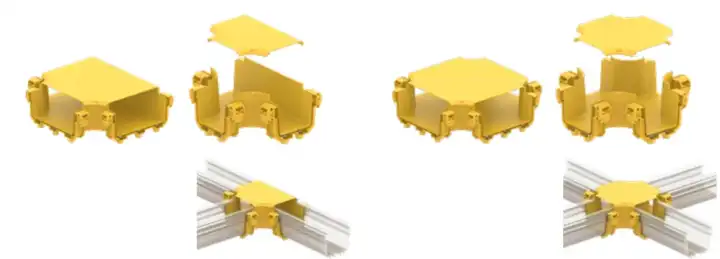
Our stocked system is a 160 × 100 mm yellow fibre duct with 2 m straight lengths, matching covers and a full set of fittings: 45° and 90° horizontal elbows, 90° up elbows, 45° and 90° down elbows, tees and crosses.
- Fibre duct straight length, 2 m and cover
- 90° horizontal elbow and 45° horizontal elbow
- 90° up elbow, 90° down elbow and 45° down elbow
- Tee and cross junctions
Sizing is where most projects go wrong. Plan for no more than 50% fill on day one and use a fitting for every change of direction. Our fibre raceway design guide gives capacity tables, a fittings guide, drop-out and storage loop layouts and a design checklist.
Microducts and Textile Innerduct
LSHF microducts for blown fibre
Microducts create a permanent, low-friction path that fibre units or micro cables can be blown into later, so new capacity can be added without opening ceilings or floors. Inside buildings, choose low smoke, halogen-free (LSHF) microducts with fire-retardant connectors. Our range includes ribbed single-way microducts in 5/3.5, 7×5/3.5, 10/6, 12/8 and 12/10 mm sizes, a 4-way 5/3.5 mm multiway bundle and matching push-fit fire-retardant connectors.
- LSHF ribbed microduct 12/8 mm
- LSHF multiway microduct 4 × 5/3.5 mm
- Fire-retardant micro connector 12/8 mm
MaxCell textile innerduct
MaxCell is a flexible, multi-cell fabric innerduct. Each cell holds one cable, so new cables can be pulled in alongside existing ones without cable-over-cable friction "burning through" the jacket of high-value fibre. It also lets more cables share an existing conduit, reducing the number of new ducts and civil works needed. The MaxCell EDGE data centre range is used in ducts and subducts between buildings and halls, and MaxCell Premise is designed for dense in-building pathways.
See our textile sub-tubing range, including MaxCell MXE3614.
Trunking, Tray and Accessories
Copper data and power need load-bearing, segregated containment. Typical choices:
| Product | Best for | Examples |
|---|---|---|
| Cable tray | Heavy power and copper bundles on overhead tiers | Galvanised medium cable tray |
| Slotted trunking | Control panels, power distribution and equipment wiring | Slotted trunking 40 × 40 mm |
| Mini and self-adhesive trunking | Short surface runs in comms rooms and offices | Mini trunking 38 × 25 mm, self-adhesive trunking |
| Couplers and DIN rail | Joining trunking and mounting equipment | Trunking coupler 100 × 100 mm, DIN rail |
Data Centre Cable Management Best Practice
Segregate by type
Give fibre, copper and power their own routes and tiers, and keep the required separation between power and data.
Design for growth
Fill containment to no more than half on day one, and leave spare microducts for future blown fibre.
Protect bend radius
Use moulded fittings, drop-outs and storage loops rather than tight hand-formed bends.
Check fire performance
Use LSHF or halogen-free materials where the fire strategy requires them.
Keep it traceable
Colour-code pathways, label both ends and record routes in your DCIM.
Support the full load
Size supports for the fully populated weight, not the day-one weight.
Cable management also affects cooling. Tidy overhead containment keeps cable bundles out of the airflow path and works with hot and cold aisle containment rather than against it.
Data Centre Cable Management FAQs
What is the best cable management for a data centre?
A tiered overhead system: an enclosed yellow fibre raceway for patch cords, cable tray or basket for copper and power on separate tiers, and microducts or textile innerduct for trunk and blown fibre between areas. Each is sized for growth and segregated by cable type.
Should fibre and copper share the same cable tray?
No. Fibre patch cords are easily crushed by heavier copper and power cables. Give fibre its own enclosed raceway and keep copper and power on separate containment.
What is the difference between a microduct and a fibre raceway?
A microduct is a small tube that a single fibre unit or micro cable is blown into, typically for longer runs between areas. A fibre raceway is a large open-top channel with covers that carries many patch cords to the racks.
What does LSHF mean?
Low Smoke Halogen Free. LSHF materials give off less smoke and no corrosive halogen gases in a fire, which is why they are specified for in-building pathways.
What is textile innerduct?
A flexible fabric sub-duct with several cells, such as MaxCell. It lets several cables share one conduit while preventing cable-over-cable friction during installation.
Planning a data centre fit-out?
Telenco UK supplies fibre raceway, microducts, textile innerduct, trunking and tray, plus the racks, containment and fibre connectivity they serve. Our team can help you specify a complete, segregated cable management system.