


Fibre Raceway Design Guide How to Size, Route and Fit Fibre Optic Ducting
Shop fibre raceway →2 m straight ductElbows, tees & crosses
Fibre raceway (also called fibre optic ducting, fibre trunking or fibre tray) is the enclosed yellow pathway that carries patch cords and jumpers above or below the racks. Done well, it protects every fibre from crushing and tight bends for the life of the data centre. Done badly, it fills up in two years and becomes the main cause of patching faults.
This guide explains how to choose the duct size, how full it should be, which fittings to use where, and how to drop fibre into cabinets safely. It is part of our wider data centre cable management guide.
Shop fibre optic ducting & raceway
Order online for UK delivery from Telenco UK
Shop the full raceway range →2 m straight duct90° horizontal elbowUp & down elbowsTeeCross
A fibre raceway is a fully enclosed, modular channel system used only for fibre optic patch cords and cables. It routes fibre from the building entry point or meet-me room to ODFs, patch panels and racks, keeps fibre apart from copper and power cabling, and uses curved fittings so that no fibre is bent tighter than its minimum bend radius.
Why Data Centres Use Dedicated Fibre Ducting
Fibre patch cords are light and fragile. Laid in open cable tray with copper and power cables, they get crushed under heavier cables, snagged during moves and bent around sharp edges. Each of these adds loss or breaks the fibre outright. A dedicated fibre duct solves this in four ways:
- Segregation. Fibre has its own route, separate from copper data and power containment. This follows the segregation principles in cabling installation standards such as EN 50174-2 and keeps the pathway easy to audit.
- Bend radius control. Every change of direction is made with a moulded fitting rather than by forcing the cable, so the curve is built into the pathway.
- Protection. Solid walls and covers stop crushing, snagging and dust build-up on connectors.
- Visibility. High-visibility yellow tells installers and other trades that this route is fibre-only, so nothing else is added later.
How to Size Fibre Optic Ducting
Undersizing is the most common mistake. It looks cheaper on day one, but a full duct cannot take new circuits without a second route, and overfilled ducts crush the cords at the bottom. It is almost always more cost-effective to over-specify capacity at the design stage.
Plan for no more than 50% fill on day one
Size the duct so that the initial installation fills it to no more than 50% of its capacity. The remaining space allows for future patch cords and keeps the weight on the lowest cords within safe limits.
Reference capacities by duct width
The table below shows typical patch cord capacities for 100 mm-high fibre ducts at 100%, 70% and 50% fill. These figures come from the Telenco Group fibre ducting range (100, 200 and 300 mm widths, per 1.8 m length) and are a useful benchmark for any system of the same cross-section.
| Patch cord diameter / fill | 100 × 100 mm | 200 × 100 mm | 300 × 100 mm |
|---|---|---|---|
| 3.0 mm cord – 100% | 980 | 1,913 | 2,847 |
| 3.0 mm cord – 70% | 686 | 1,339 | 1,993 |
| 3.0 mm cord – 50% | 490 | 957 | 1,423 |
| 2.0 mm cord – 100% | 2,205 | 4,305 | 6,405 |
| 2.0 mm cord – 50% | 1,103 | 2,153 | 3,203 |
| 1.6 mm cord – 100% | 3,445 | 6,727 | 10,008 |
| 1.6 mm cord – 50% | 1,723 | 3,363 | 5,004 |
What about our 160 × 100 mm duct? Interpolating between the 100 mm and 200 mm figures gives an estimate of roughly 770 × 3.0 mm cords, 1,730 × 2.0 mm cords or 2,700 × 1.6 mm cords at 50% fill. Treat these as planning estimates, not guaranteed values, and talk to our team if your design is close to the limit.
Allow for weight
Fibre adds up. In the reference range, a fully loaded 100 × 100 mm duct carries around 14.6 kg of 3.0 mm patch cords per 1.8 m length, and a 300 × 100 mm duct over 42 kg. Support the duct at every joint and either side of each fitting, and design the suspension (for example threaded rod and brackets, or brackets from the cable ladder) for the fully loaded weight, not the day-one weight.
Fibre Raceway Fittings Explained
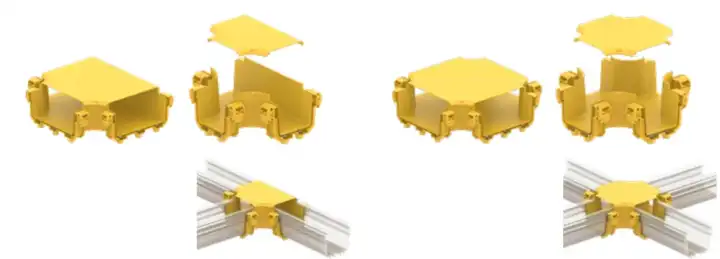
Never bend the duct on site
Each change of direction or junction has its own moulded fitting with a smooth internal radius. Cutting and forcing straight duct round a corner creates a sharp edge and a tight bend, which is exactly what the system is there to prevent.
| Fitting | What it does | Typical use | Joiners needed* |
|---|---|---|---|
| Straight length + cover | Main straight run | Spine along the hall and along each row | 1 per joint |
| 90° horizontal elbow | Turns 90° on the same level | End of a row, around a column | 2 |
| 45° horizontal elbow | Gentle 45° turn on the same level | Offsets and obstructions (use in pairs) | 2 |
| 90° up elbow | Turns the route upwards | Rising over obstructions or to a higher tier | 2 |
| 90° down elbow / 45° down elbow | Turns the route downwards | From the overhead spine towards ODFs and frames | 2 |
| Tee | Three-way junction | Branching the main spine into each row | 3 |
| Cross | Four-way junction | Where two routes intersect | 4 |
*For our 160 × 100 mm range, fittings connect with TFD-16JO duct joiners. Every fitting is sold as a body with a separate matching cover, so remember to order both.
Couplers and covers
Modern fibre ducting systems use push-fit couplers with clamping levers, so channels and fittings connect without drilling, cutting or extra brackets. Where a route needs extra strength, a quick knob with T-bolt can be added by hand. Covers on premium systems are hinged and open to around 90° in one direction only, so decide the opening side before installation: the side your technicians will stand on when patching.
Dropping Fibre into Cabinets and Storing Slack
The point where fibre leaves the overhead duct and enters the rack is where most damage happens. Use a purpose-made drop-out rather than cutting a hole in the duct wall:
- Quick drop / inline drop – fits on top of the channel and guides cords over a curved edge down to the rack below.
- Offset drop – lowers fibre to one side of the duct when the rack is not directly underneath.
- Trumpets – horizontal or vertical flared outlets that keep the bend radius as cords exit.
- Vertical channel or flex tube – an enclosed path from the duct down to the cabinet roof, protecting cords over the full drop.
When planning drop positions, allow for the horizontal and vertical offset of each outlet so that suspension brackets do not clash with the drop.
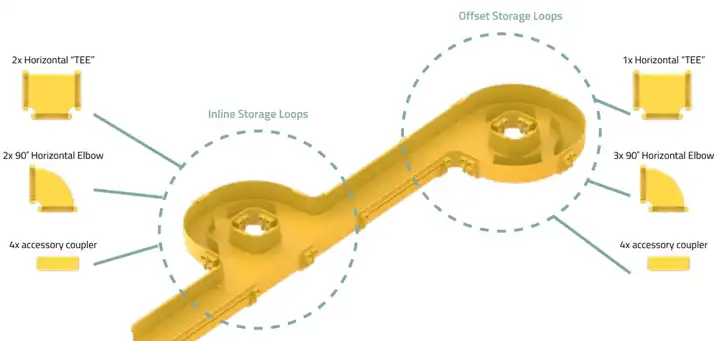
Fibre storage loops
Excess patch cord length should be stored inside the system, not coiled on top of a cabinet. An inline storage loop keeps slack within the run of the duct (built from two horizontal tees and two 90° elbows). An offset storage loop takes the slack away from the main duct (built from one tee and three 90° elbows). Both keep the cords at a safe radius and easy to trace.
Materials and Fire Performance
Fibre ducting is made from rigid plastics. Our stocked 160 × 100 mm system is PVC. Premium systems use flame-retardant PC+ABS rated UL 94 V-0, halogen-free to IEC 61249-2-21 and RoHS compliant, with no PVC content. If the data centre's fire strategy calls for low smoke, halogen-free containment, check the material before you specify. Talk to us about halogen-free options for your project.
Fibre Raceway Design Checklist
Count the cords
Estimate today's and five-year patch cord numbers and their diameters.
Pick the width
Choose the duct where five-year demand is no more than 50% fill.
Map the route
Spine, row branches (tees), crossings (crosses) and level changes (up and down elbows).
Plan every drop
One drop-out per rack position, plus storage loops for slack.
Design the supports
Support every joint and fitting for the fully loaded weight.
Order complete kits
Bodies, covers and the right number of joiners for each fitting.
Fibre Raceway FAQs
What is the difference between fibre raceway, fibre ducting and fibre trunking?
They are different names for the same thing: an enclosed, usually yellow, channel system dedicated to fibre optic patch cords. "Raceway" is common in the US and in manufacturer literature, while "ducting" and "trunking" are more common in the UK.
How full should a fibre duct be?
Plan for no more than 50% fill at initial installation. This leaves capacity for growth and prevents the cords at the bottom of the duct being crushed.
How many patch cords fit in a 160 × 100 mm fibre duct?
As a planning estimate, roughly 770 × 3.0 mm, 1,730 × 2.0 mm or 2,700 × 1.6 mm patch cords at 50% fill, interpolated from 100 mm and 200 mm reference capacities. Confirm critical designs with our technical team.
What bend radius do fibre raceway fittings protect?
Fittings are designed so fibre is not bent tighter than about 30 mm, which covers most standard and bend-insensitive patch cords. Always check the minimum bend radius on the cord's datasheet.
Why is fibre ducting yellow?
Yellow is the conventional colour for fibre pathways. It identifies the route as fibre-only, so other trades do not add copper or power cables to it.
Do fibre duct fittings come with covers and joiners?
In our 160 × 100 mm range each fitting body and its cover are sold separately, and fittings join with TFD-16JO joiners: two per elbow, three per tee and four per cross.
Need help designing a fibre route?
Send us your floor plan and patch cord counts and our team will help you size the duct, list the fittings and plan the drops.