



Hot Aisle vs Cold Aisle Containment: Data Centre Cooling Explained
Aisle containment is an important part of effective data centre cooling, helping to manage airflow, reduce the mixing of hot and cold air, and improve the operating environment around critical IT equipment.
But what is the difference between hot aisle containment and cold aisle containment, and which approach is better suited to your data centre?
This guide explores how both systems work, their key differences, and how RACKEON® aisle containment solutions support modern data centre infrastructure.
Aisle containment is a data centre airflow management system that physically separates hot exhaust air from the cool supply air delivered to IT equipment. By reducing the mixing of these air streams, containment can improve cooling efficiency, support more consistent inlet temperatures and help optimise the performance of cooling systems.
How Does Data Centre Aisle Containment Work?
Servers and other IT equipment generate heat during operation. In a typical front-to-rear airflow configuration, cool air enters through the front of the equipment, while heated air is discharged through the rear.
Without effective airflow management, hot exhaust air can mix with the cool supply air. This can lead to uneven rack inlet temperatures and place additional demands on the cooling infrastructure.
Aisle containment introduces a physical separation between these air streams using panels, doors and roof containment structures.
Separate Airflow
Physical containment reduces the mixing of cool supply air and hot exhaust air.
Control Temperatures
More predictable airflow helps cooling systems maintain appropriate equipment inlet temperatures.
Optimise Cooling
Improved separation can reduce unnecessary cooling demand and support more efficient operation.
Both hot aisle containment and cold aisle containment use this principle. The key difference is which air stream is enclosed.
What is Hot Aisle Containment (HAC)?
Hot aisle containment (HAC) is a data centre cooling arrangement that encloses the hot aisle between rows of server racks.
Heated exhaust air from the rear of the equipment is contained within the enclosed aisle and directed towards the cooling return system, depending on the facility design.
This reduces the opportunity for hot exhaust air to recirculate into the cold air supply.
Advantages of Hot Aisle Containment
- Helps prevent hot exhaust air from mixing with cool supply air.
- Supports more predictable rack inlet temperatures.
- Can improve cooling system efficiency when properly designed.
- Suitable for data centre configurations designed around controlled hot air return paths.
- Can be incorporated into modular data centre layouts.
Hot aisle containment should be designed with the wider cooling strategy, equipment airflow direction, maintenance access and applicable fire safety requirements in mind.
What is Cold Aisle Containment (CAC)?
Cold aisle containment (CAC) encloses the cold aisle between rows of server racks, creating a controlled area for the delivery of cool air to equipment inlets.
By separating the cool supply air from surrounding warmer air, cold aisle containment helps reduce unwanted air mixing and supports more consistent inlet conditions.
Advantages of Cold Aisle Containment
- Helps maintain separation between cool supply air and hot exhaust air.
- Supports consistent cooling conditions at equipment inlets.
- Can be integrated into existing data centre cooling layouts.
- Offers modular configurations for different rack arrangements.
- Can support cooling efficiency improvements when properly specified.
Cold aisle containment is often considered where the existing cooling arrangement is well suited to supplying conditioned air directly into an enclosed aisle.
Hot Aisle vs Cold Aisle Containment: Key Differences
Both approaches aim to improve airflow separation and cooling performance. The most suitable option depends on the existing infrastructure and the design of the cooling system.
| Feature | Hot Aisle Containment | Cold Aisle Containment |
|---|---|---|
| Air stream enclosed | Hot exhaust air | Cool supply air |
| Primary objective | Contain and direct heated return air | Protect cool air delivered to equipment |
| Typical airflow | Hot air discharged into enclosed aisle | Cool air supplied into enclosed aisle |
| Cooling integration | Requires a suitable hot air return strategy | Requires a suitable cool air supply strategy |
| Energy efficiency | Can improve efficiency through airflow separation | Can improve efficiency through airflow separation |
| Retrofit suitability | Depends on existing cooling and rack layout | Depends on existing cooling and rack layout |
| Key design consideration | Hot air return path and enclosed aisle conditions | Cool air delivery and enclosed aisle conditions |
Neither method is automatically the best solution for every facility. The choice should be based on airflow design, equipment layout, cooling capacity, maintenance access and future expansion plans.
What Are the Benefits of Aisle Containment Systems?
Effective aisle containment can contribute to improved thermal management and more efficient operation of data centre cooling infrastructure.
Improved Cooling Efficiency
By reducing hot and cold air mixing, aisle containment can help cooling systems operate more effectively.
Potential Energy Savings
Improved airflow management may reduce unnecessary cooling energy demand, depending on the wider cooling system and operating conditions.
Enhanced Equipment Performance
More consistent inlet temperatures can help maintain suitable operating conditions for servers and other IT equipment.
Improved Power Usage Effectiveness
Reducing cooling overhead can contribute to a lower Power Usage Effectiveness (PUE), although actual results depend on facility performance.
Modular and Scalable
Modular containment systems can be incorporated into new data centre installations and selected retrofit projects.
Retrofit Friendly
Adaptable panel, roof and door configurations can support containment upgrades in existing facilities where site conditions permit.
RACKEON® Aisle Containment Systems
The RACKEON® Aisle Containment System is engineered to maximise thermal efficiency and airflow control within high-density, mission-critical data centre environments.
Featuring robust steel frameworks and modular roof and blanking panel options, the system provides separation between hot and cold air streams.
This helps reduce bypass airflow and supports improved cooling performance and PUE.
RACKEON® containment solutions are designed for integration into new installations and suitable retrofit projects, with configurations tailored to the requirements of the data centre.
Modular Roof and Panel Options
Roof and blanking panel configurations can be adapted to the installation layout and cooling requirements.
Flexible Aisle Widths
Depending on rack depth and configuration, aisle widths can vary between 1000mm, 1200mm and 1800mm.
Sliding Door Configurations
Single or double sliding door arrangements may be specified, depending on the containment layout.
Optional Door Automation
Sliding doors can be configured with optional automation and associated access control.
The system can be configured for different rack layouts, with suitable blanking panels installed where required to support containment integrity.
The Telenco UK design team can work on a project-by-project basis to determine the most appropriate RACKEON® containment arrangement.
Explore Hot and Cold Aisle Containment Solutions
Discover RACKEON® aisle containment solutions for server rack and colocation environments.

RACKEON® Hot Aisle Containment (HAC)
Designed to contain heated exhaust air within the hot aisle, helping to reduce recirculation and support efficient data centre cooling.
Modular construction enables the system to be configured around rack layouts, access requirements and cooling design.
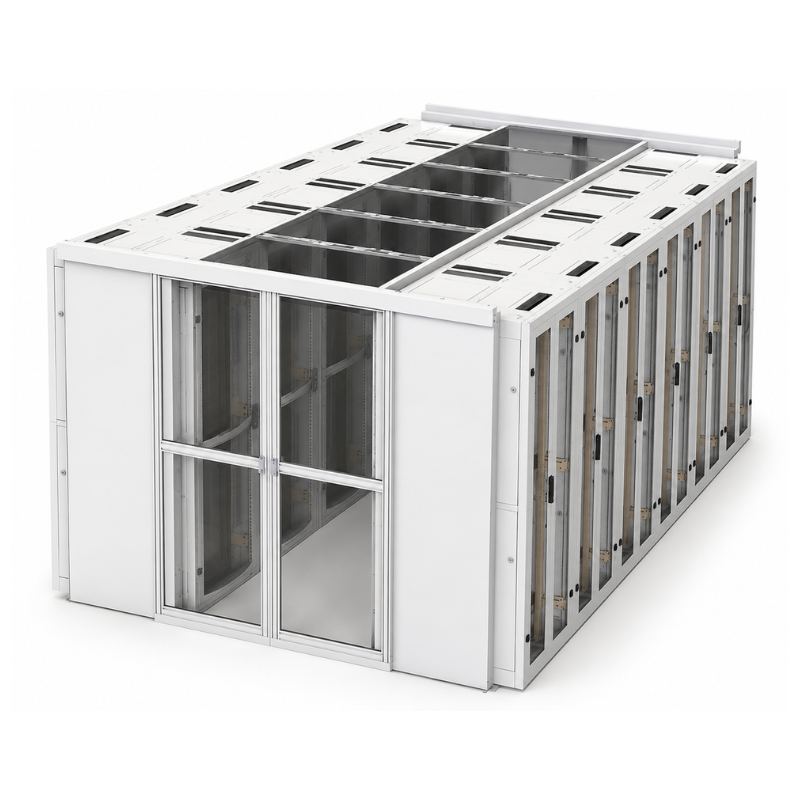
RACKEON® Cold Aisle Containment (CAC)
Designed to enclose the cool supply air aisle, helping to maintain separation from surrounding hot exhaust air.
Flexible roof, panel and door configurations support integration with compatible server rack layouts and cooling systems.
Both RACKEON® solutions are available through Telenco UK, with project-specific configurations and technical guidance available for suitable installations.
How to Choose Between Hot and Cold Aisle Containment
The most appropriate containment solution depends on the facility's cooling design and operational requirements.
- Assess the existing cooling system. Determine how cool air is supplied and how heated air is returned.
- Review rack orientation. Confirm the equipment airflow direction and the arrangement of server rack rows.
- Consider aisle dimensions. Review rack depths, available aisle widths and access requirements.
- Evaluate roof and door configurations. Select suitable roof panels, sliding doors and any required automation.
- Check fire safety requirements. Ensure containment arrangements are coordinated with the facility's fire detection and suppression strategy.
- Plan for future expansion. Consider whether additional racks, cooling equipment or changes to infrastructure may be required.
- Seek project-specific guidance. Work with the Telenco UK team to establish a suitable RACKEON® containment configuration.
Planning a Data Centre Aisle Containment Project?
From new data centre installations to suitable retrofit projects, RACKEON® aisle containment systems can be configured around your rack layout and cooling strategy.
Explore Aisle Containment SolutionsData Centre Aisle Containment FAQs
What is the difference between hot aisle and cold aisle containment?
Hot aisle containment encloses the heated exhaust air between server rack rows. Cold aisle containment encloses the cool supply air delivered to equipment inlets. Both approaches reduce unwanted air mixing, but they use different airflow arrangements.
Does aisle containment improve data centre cooling efficiency?
Aisle containment can improve cooling efficiency by separating hot and cold air streams. This reduces unwanted air mixing and can help cooling equipment operate more effectively. Actual performance depends on the cooling system and facility design.
What is hot aisle containment?
Hot aisle containment is a data centre airflow management method that encloses the hot exhaust aisle between server racks. It helps direct heated air towards the cooling return system and reduces recirculation into equipment inlets.
What is cold aisle containment?
Cold aisle containment encloses the area supplying cool air to server equipment. The enclosure helps maintain separation between conditioned supply air and surrounding warmer air, supporting more consistent equipment inlet temperatures.
Can RACKEON® aisle containment be retrofitted into an existing data centre?
RACKEON® aisle containment can be considered for existing data centres, subject to rack layout, cooling configuration, available space and safety requirements. Its modular design supports adaptation to different project conditions.
What is PUE in a data centre?
Power Usage Effectiveness (PUE) is a metric comparing total facility energy consumption with the energy used by IT equipment. A lower PUE indicates less non-IT energy overhead. Improved cooling efficiency can contribute to better PUE performance.
What aisle widths are available for RACKEON® containment systems?
RACKEON® aisle containment configurations can accommodate aisle widths of approximately 1000mm, 1200mm or 1800mm, depending on the rack depths and project arrangement. The appropriate dimensions should be confirmed during system design.
Improve Data Centre Airflow with RACKEON® Aisle Containment
Whether you are planning a new data centre or upgrading an existing installation, RACKEON® aisle containment solutions can help support effective airflow management and cooling performance.
Explore our hot and cold aisle containment systems or contact the Telenco UK team to discuss your project requirements.